
This case study is based on a real instruction. Names, addresses and identifying details have been changed, and figures rounded, to protect client confidentiality.
The instruction
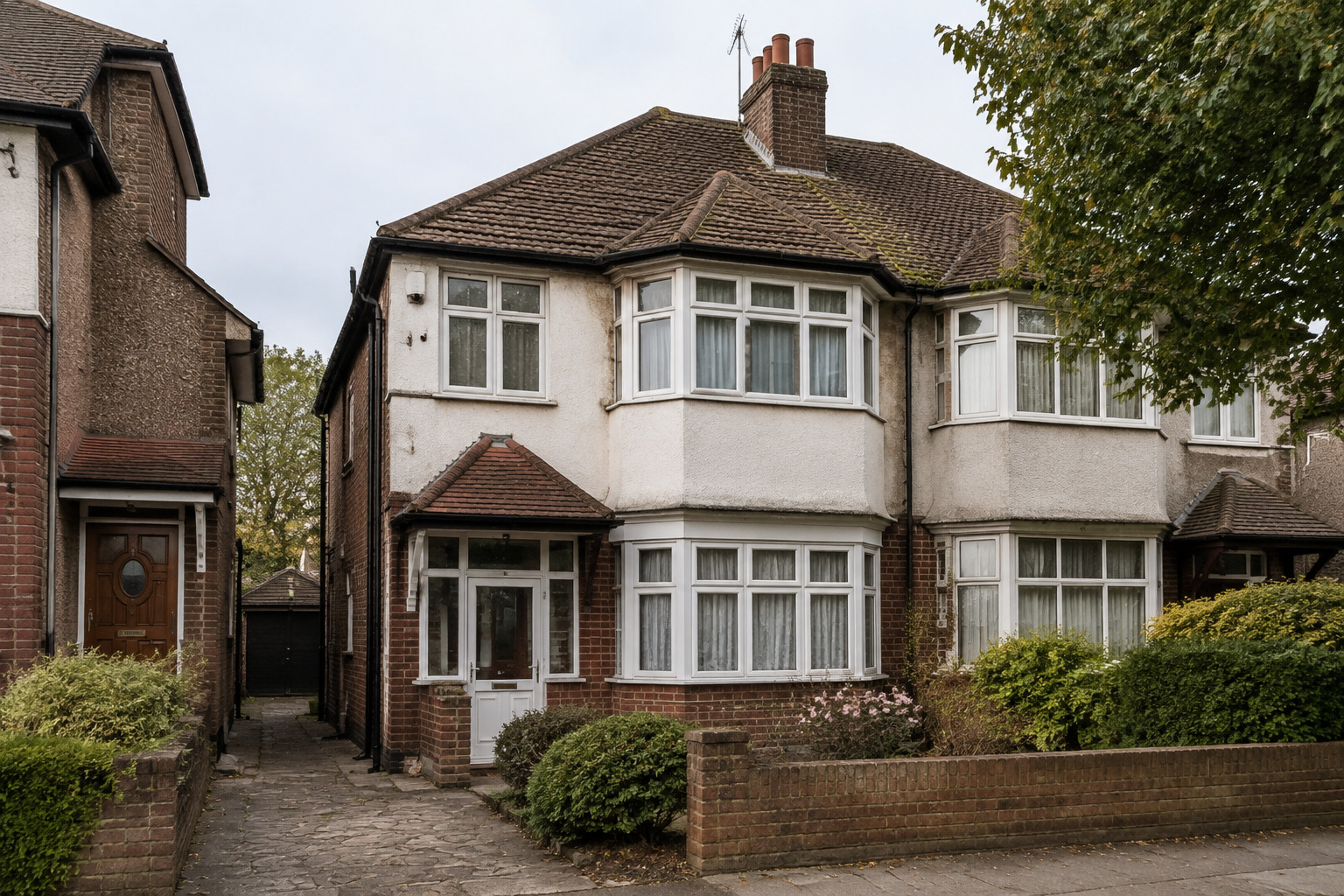
We were instructed by the executor of an estate to prepare a Red Book Market Valuation of a three-bedroom 1930s semi-detached house in New Malden for probate and inheritance tax purposes, as at the date of death.
The executor had already obtained two estate agents’ appraisals, at £650,000 and £675,000. She was uneasy about both. The house had been occupied by the deceased for over forty years, had not been modernised since the 1980s, and had significant issues she was fairly sure the agents had not priced in.
The statutory basis
Section 160 of the Inheritance Tax Act 1984 defines value for IHT purposes as the price which the property might reasonably be expected to fetch if sold in the open market at the relevant time. Two points follow, and both matter:
- No reduction is permitted on the basis that the whole estate is being placed on the market at once. Each asset is valued as if sold individually.
- The valuation is of the property in its actual condition at the date of death — not as it might be after works, and not in the tidied and staged condition in which an agent might expect to market it.
What the inspection revealed
The property was structurally sound but comprehensively dated and, in places, defective:
- original 1930s electrical installation with later partial additions, requiring a full rewire;
- a boiler and heating system beyond economic repair;
- single-glazed steel windows throughout, with corrosion to several frames;
- a kitchen and two bathrooms requiring complete replacement;
- a covering to part of the roof at the end of its life, with two areas of active water ingress and consequent ceiling damage;
- textured coatings and pipe lagging requiring specialist survey before any works;
- an outdated and non-compliant layout at ground floor which the market would expect to be reconfigured.
The methodology
Where a property requires comprehensive refurbishment, the market does not price it by discounting a modernised comparable by a vague percentage. The purchasers competing for this house — and the evidence showed they were predominantly developers and improving owner-occupiers — price it residually. So did we.
| Element | Figure |
|---|---|
| Gross development value (fully refurbished, evidenced by comparables) | £750,000 |
| Less: refurbishment costs | (£108,000) |
| Less: remediation (asbestos survey and removal, roof and water damage) | (£19,000) |
| Less: contingency | (£12,700) |
| Less: purchaser’s risk and profit | (£35,300) |
| Adopted Market Value | £575,000 |
We cross-checked the result against completed sales of comparable unmodernised properties in the immediate area, which supported the figure.
Why the difference from the agents’ figures matters
An agent’s appraisal is a marketing document. It is prepared to win an instruction, it is not prepared to a professional standard, and it carries no liability. There is nothing improper about that — it simply is not a valuation.
The consequences of using one for probate run both ways:
- Overvaluation means the estate pays inheritance tax at 40% on value that does not exist. On a £75,000 overstatement in a taxable estate, that is £30,000 of tax paid unnecessarily.
- Undervaluation invites enquiry from HMRC, referral to the Valuation Office Agency, interest on unpaid tax and potentially penalties for failure to take reasonable care. Executors are personally responsible for the accuracy of the account they submit.
A Red Book valuation by an RICS Registered Valuer is the executor’s protection on both sides of that line: it produces a defensible figure, and it evidences that reasonable care was taken.
Two further points executors should know
The probate value becomes the beneficiaries’ base cost
If a beneficiary later sells the property, their capital gains tax base cost is the probate value. Understating it for IHT — even where no IHT is payable because the estate falls within the nil-rate bands — simply moves the tax into CGT on a later sale.
Loss on sale relief
Where an interest in land forming part of an estate is sold within four years of death for less than the probate value, section 191 of IHTA 1984 may allow the sale price to be substituted, generating an IHT refund. The relief has conditions and interacts with other disposals from the estate, so it should be considered with the estate’s advisers before any sale is committed to.
The current thresholds
For 2026/27, the nil-rate band remains at £325,000 per person and the residence nil-rate band at up to £175,000 where a qualifying home passes to direct descendants, tapering where the estate exceeds £2 million. Both are frozen until April 2031. With unused allowances transferable between spouses and civil partners, a couple may pass up to £1 million free of inheritance tax. Above the available thresholds, IHT is charged at 40%.
Because the thresholds are frozen while property values are not, estates that were comfortably below the threshold a decade ago are increasingly not. Accurate property valuation is a larger part of the picture than it used to be.
Frequently asked questions
Do I need a RICS valuation for probate?
Where the estate may be liable to inheritance tax, or where the property is unusual, tenanted, jointly owned, in poor condition or otherwise difficult to value, a Red Book valuation by an RICS Registered Valuer is strongly advisable. It gives a defensible figure and evidences that the executor took reasonable care. For a straightforward estate well within the nil-rate bands, estate agents’ appraisals may be sufficient.
What is a section 160 valuation?
Section 160 of the Inheritance Tax Act 1984 defines the value of property for IHT as the price it might reasonably be expected to fetch if sold in the open market at the relevant time, with no reduction permitted for the fact that the whole estate is being sold at once. A “section 160 valuation” is simply a valuation carried out on that statutory basis.
What date should the probate valuation be at?
The date of death. This is why a retrospective valuation is often required — estates are frequently administered months after death, and the valuation must reflect the market as it stood on the relevant date, not when the valuer attends.
What happens if HMRC disagrees with the probate value?
HMRC may refer the valuation to the Valuation Office Agency, who will form their own view and, if it differs, open a negotiation. A properly evidenced Red Book report is what that negotiation is conducted on, and in our experience a well-supported valuation is usually accepted or settled close to the reported figure.
Acting as an executor?
Blakes Chartered Surveyors prepare Red Book Market Valuation reports for probate and inheritance tax for executors, solicitors and accountants across London and the South East. Reports are delivered within 5–10 days of inspection on a fixed fee agreed before we start, with urgent instructions often turned around within 24 hours.
Call 020 7373 7373 or email info@blakessurveyors.com.


